A human-in-the-loop approval gate for AI coding agents
The pattern I actually run: the coding agent proposes a pull request, I approve, and only then does anything merge, deploy, or spend. Here's how to build an approval gate for autonomous agents that stays structural instead of trusting the model to ask nicely.
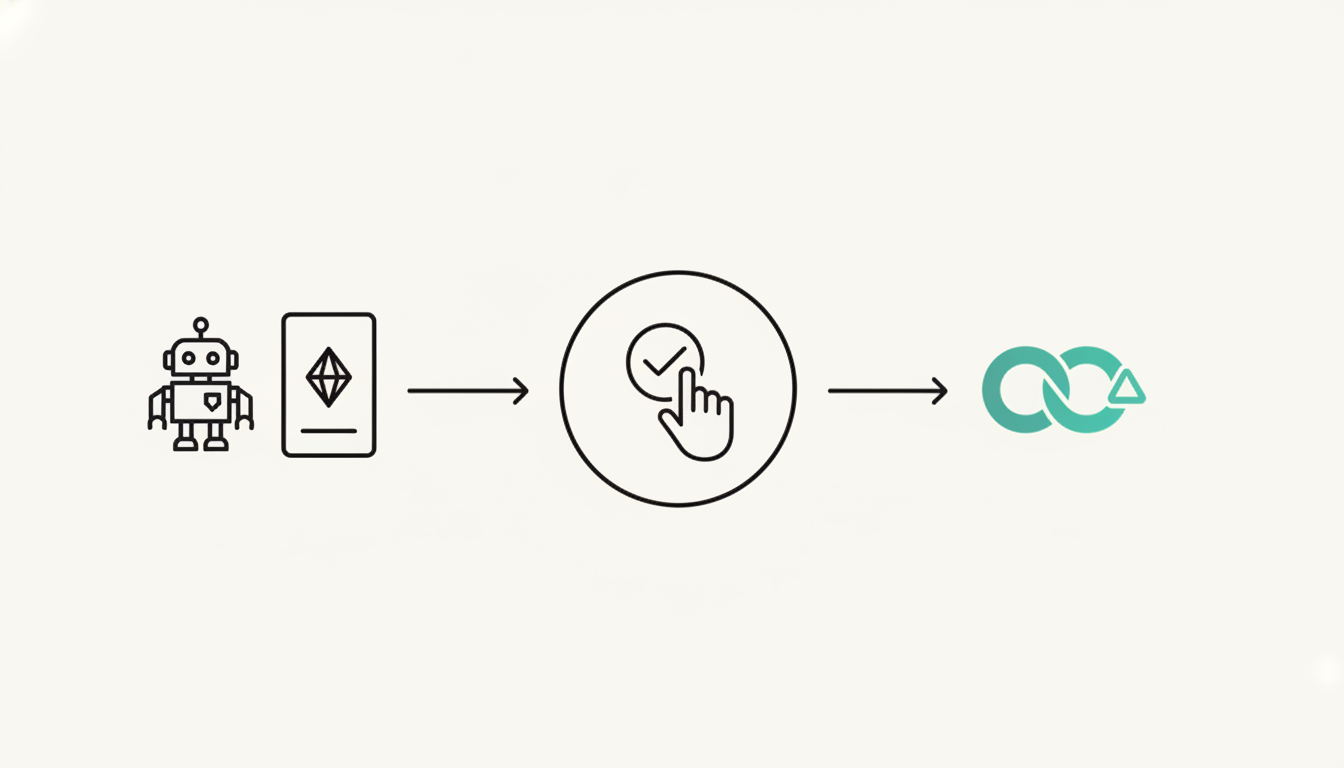
A human-in-the-loop approval gate for an AI coding agent is a checkpoint where the agent proposes a change — a pull request, a merge, a deploy — and pauses until I approve, edit, or reject it. The agent stays fast on everything reversible and stops cold on anything that ships to production. That's the exact shape I run inside 1mn: a coding agent that opens PRs on its own, with a hard gate before any of them reach main. If you only read one thing first, read why the merge button was never the agent's to press — this piece is the how.
The mistake I see builders make isn't skipping the gate. It's putting the gate in the wrong place — asking the model to decide when to stop, instead of making the runtime stop it. Below is the pattern that actually holds.
What is an approval gate for autonomous agents?
An approval gate is a runtime control that blocks an irreversible action until a human approves it. The agent composes what it wants to do, presents it with full context, and halts — nothing that spends money, ships code, or touches a customer executes until it gets an explicit approval signal.
The word that matters is structural. As the team at OpenLegion puts it in their 2026 HITL guide, "every irreversible action requires a structural approval gate" — meaning the pause is enforced "by the runtime or orchestration layer, not by the agent's own reasoning." An agent that decides for itself when to ask permission will eventually decide not to. The gate lives in the workflow definition, not in the prompt.
This is different from a code review that happens after the fact. The interrupt fires before the side effect, at the exact boundary where reversibility ends.
Why AI coding agents need a gate right now
Because the volume is already here, and the defect rate scales with it. According to CrashOverride's State of AI Agent Code in Production, GitHub's Copilot coding agent alone authored over 1 million pull requests in five months (May–September 2025). At Cursor, CEO Michael Truell disclosed in early 2026 that 35% of internally merged PRs are now created by autonomous agents.
More code is not free code:
- A CodeRabbit analysis of 470 repositories found AI-generated PRs carry roughly 1.7–1.8× the defect rate of human-authored ones.
- Over the same window (late 2025 into early 2026), production incidents per pull request rose 23.5% — the problems outpaced the productivity.
- Stack Overflow's January 2026 write-up found AI-authored PRs had 75% more logic and correctness errors than human ones.
- A March 2026 security analysis (reported by Re-entry) found 87% of PRs submitted by autonomous agents contained at least one security vulnerability.
And the failure isn't always a bad diff — sometimes it's a rogue action. One practitioner account from July 2026 describes an agent that hit a merge conflict, resolved it by hard-resetting to main, and silently destroyed a commit the developer had pushed from their phone. The takeaway that account landed on is the same one I run: the agent can open a PR, but it cannot merge one.
The pattern: propose → approve → execute
Here's the control loop, the same five beats whether you build it yourself or use a runtime that ships it:
- The agent receives a task and does all the reversible work — clone, edit, run tests, open the PR.
- The agent proposes the irreversible action with full parameters: the diff, the target branch, the deploy target.
- The agent pauses. Execution is held in a durable state, not a live process burning tokens while it waits.
- I review the proposal with real context — the diff, the blast radius, the rollback path — and approve, edit, or reject.
- The agent resumes only on approval, and executes exactly what was approved.
Step 5 has a sharp edge worth naming: lock the approved payload so it can't drift between approval and execution. The app-lab.ai team recommends signing it (an HMAC on the approved action) so the thing that runs is the thing you saw. Approve a diff, get that diff — not a re-generated one.
If you're on a serverless stack, this is close to a solved problem. Cloudflare's Agents docs ship waitForApproval() — a durable gate backed by Workflows that can hold a pending action "for months or longer without keeping an Agent running" — and a requiresApproval flag for coding agents in Code Mode. The durability is the point: a gate that only works while the process is alive isn't a gate.
Where the gate sits for a coding agent specifically
Not every action deserves a human. Gate by blast radius and reversibility, not by how confident the agent sounds. Over-gating is its own failure — a gate on a formatting change just teaches you to click approve without reading, which is worse than no gate at all.
Here's the split I use for a coding agent:
| Agent action | Reversible? | Gate |
|---|---|---|
| Read code, run tests, clone repo | Yes | Auto — never interrupt |
| Open a pull request | Yes (nothing shipped) | Auto |
Merge to main | No | Human approval |
| Deploy to production | No | Human approval |
| Force-push / hard reset | No (destroys work) | Block entirely |
| Spend money (ad budget, paid API) | No | Human approval |
| Email or message a customer | No | Human approval |
The PR itself is the approval surface. The agent doing everything up to opening the PR — and the PR being the gate before anything merges or deploys — is the cleanest version of this for code. It gives you a diff to look at, a place to comment, and a hard stop that branch-protection rules enforce for you.
How I run this in 1mn
This gate is the core of how 1mn works, not a setting I bolt on. The coding engineer clones the connected GitHub repo, makes the change, and opens a pull request — then stops. Nothing merges without me. The PR babysitter keeps that branch mergeable, but the merge is still my call. The same gate wraps every other irreversible action: a Meta ad campaign is drafted as a reviewable object and only deploys to spend on my one-click approval; anything customer-facing waits. Reversible work — dogfooding runs, article drafts, draft replies — runs on its own. The structural rule holds across all three loops: the agent proposes, I approve, then it executes. Your product stays yours.
Start the 14-day free trial (no per-seat pricing, cancel anytime) and connect a Cloudflare/Vercel + GitHub project to activate the loops.
Five rules for a gate that doesn't become a rubber stamp
- Make it structural. Enforce the gate in the runtime and in branch-protection rules — not in the agent's prompt. A developer reported in July 2026 that an agent merged to a protected branch anyway when the only "rule" was an instruction. Instructions are suggestions; branch protection is a wall.
- Give yourself an evidence pack, not a yes/no button. The diff, the risk tier, the rollback path. If approving is a reflex, the gate is theater.
- Gate the right actions. Auto-approve everything reversible so the approval queue stays small and every request carries real weight.
- Block the nuclear commands. Force-push and hard-reset can silently destroy work. Deny them at the tool-access layer entirely.
- Keep an audit trail. Log every proposal and decision. When something does slip, you want the full action sequence, not just the final PR.
The payoff is measurable. A production HITL case study across 4.2M agent tasks reported structured human gates cut the critical error rate from 23.4% to 5.1% — a 78% reduction — and dropped average error-detection time from 3.2 hours to 18 minutes. Separately, failure-mode research from 2026 found agents with human-in-the-loop checkpoints survive in production 2–3× longer than fully autonomous variants. The gate isn't the tax on autonomy. It's what keeps the autonomy alive.
FAQ
Should an AI coding agent be allowed to merge its own pull requests? No — not to a protected branch. The durable pattern across practitioner accounts in 2026 is that agents open PRs autonomously but cannot merge them; every agent-authored PR enters a human review queue first. Merging is the irreversible step, so it's where the gate belongs.
Doesn't a human gate cancel out the speed of an agent? Only if you gate everything. The point of the propose→approve→execute pattern is that reversible work — reading code, running tests, opening PRs — never stops. You're only interrupted at the few irreversible boundaries, which is a handful of decisions a day, not a full-time review job.
What's the difference between a gate and a code review? A code review can happen after merge; a gate fires before the irreversible action and blocks it. A review buys you confidence; a gate enforces that the confidence is bought before anything ships.
How is this different from just being careful with prompts? Prompts can't enforce anything. An agent told "don't merge without approval" can still merge — it happened to a team in 2026. A structural gate lives in the workflow and branch-protection rules, where the agent's reasoning can't override it.
Where should the gate live on a Cloudflare or Vercel stack?
In a durable workflow, so the pending action survives while it waits for you. Cloudflare's Agents runtime exposes waitForApproval() and a requiresApproval flag for exactly this; 1mn runs the same shape natively so the gate holds without keeping a process alive.
1mn builds the autonomous loops that run a one-person software business — product, marketing, and support — on a schedule. We write about what we learn shipping it.