What Does It Actually Cost to Run Autonomous AI Agents in 2026?
The token bill is the number on the pricing page — and it's 8-27% of what an autonomous agent really costs to run. Here's the full 2026 cost breakdown, the runaway-weekend-bill trap, and how I keep the meter bounded when agents run my solo SaaS on a cron.
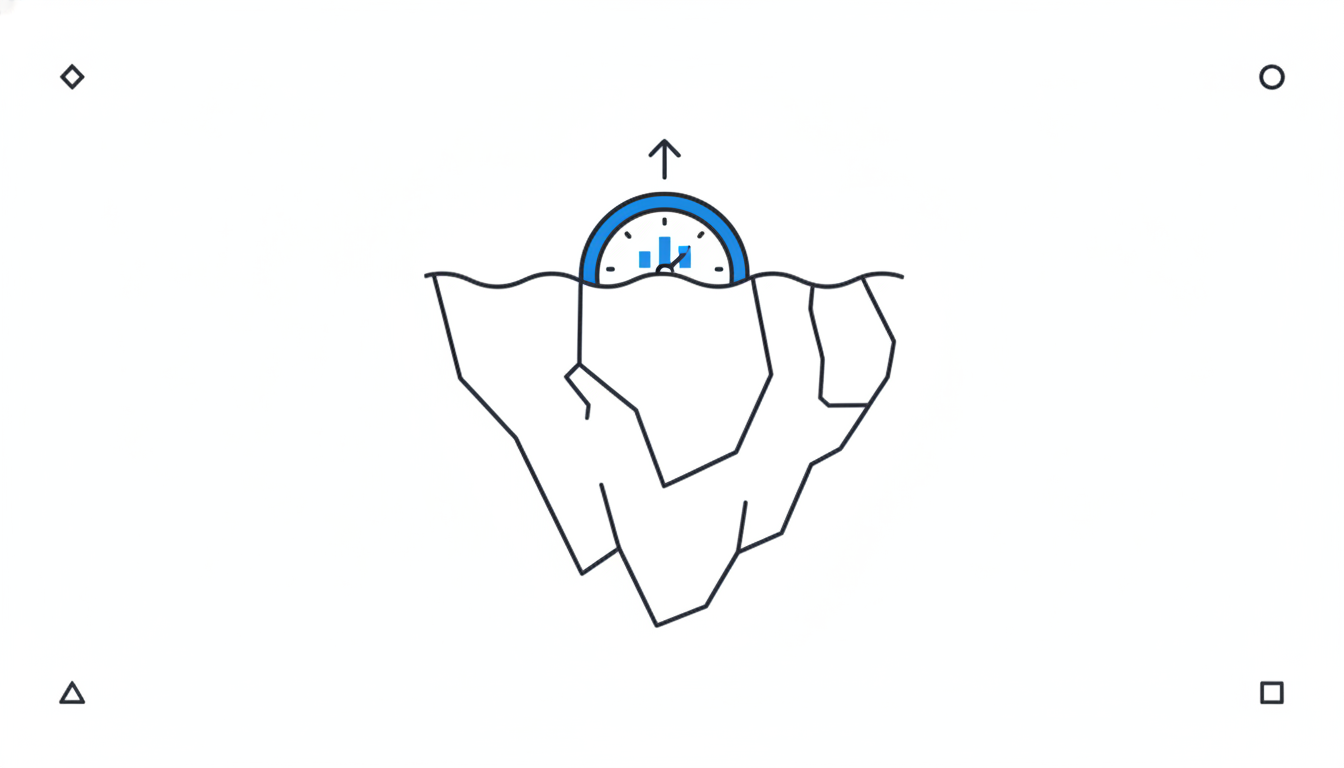
Running an autonomous AI agent in 2026 costs far more than the token bill — the model invoice is only 8-27% of the real number. According to the Digital Applied AI Agent Build & Run Cost Index 2026 (July 2026), model tokens are 8% of a simple agent's monthly run cost and 27% of a multi-agent system's. The rest is retries, re-sent context, infrastructure, and the cost of the agent being wrong. If you run loops instead of an open-ended agent — bounded jobs on a cron with a human gate on spend, like the ones I run my solo SaaS on with 1mn — you cap the part that actually blows up the bill.
So before you leave an agent running over a weekend, here's what the meter is really measuring.
What does one autonomous agent cost per month?
Between roughly $800 and $6,250 per month per agent in fully-loaded run cost, depending on how much it does. The Digital Applied index (July 2026) puts a simple task agent at ~$800/month to run, a RAG-workflow agent at ~$2,700, and a multi-agent system at ~$6,250. A separate 2026 analysis from Bartosz Cruz lands wider — $2,000 to $32,000/month per agent once infrastructure, observability, and human review are all counted.
The spread is huge because "cost of an agent" isn't one number. It's a stack:
- Model tokens — the API invoice everyone quotes.
- Retries and reflection loops — every failed attempt and self-correction pass re-runs the reasoning.
- Re-sent context — the conversation and tool outputs shipped back to the model on every single step.
- Infrastructure — orchestration, vector stores, queues, hosting.
- Human review — your time, at your rate, reviewing what the agent produced.
The token line is the one on the pricing page. It's also the smallest one.
Why the token bill lies
The API bill represents roughly 10-20% of the true total cost of running agents in production, according to a April 2026 analysis by tianpan.co. The Cockroach Labs agentic AI costs report (June 2026) puts inference at about 20% of total cost of ownership. So the number you optimize against is a fifth of the number you actually pay.
Worse, the token line itself is deceptive. Per-token prices are falling fast — the blended cost of AI dropped 67% year-over-year, from $18.40 to $6.07 per million tokens, per Zylos Research (June 2026). But your bill isn't falling, because agents consume orders of magnitude more tokens than a chatbot ever did.
Two multipliers do the damage:
- Agentic workflows use 5-30x more tokens per task than a standard chatbot query (Gartner, March 2026, via Cockroach Labs). A single agentic session can burn 1-3.5 million tokens.
- Re-sent context accounts for 62% of total agent inference bills, according to the Stanford Digital Economy Lab (2025). Every step ships the whole growing transcript back to the model. The reasoning is cheap; the re-reading is what you pay for.
A 10-cycle reflection loop can consume 50x the tokens of a single pass (tianpan.co, April 2026). That's not an edge case. That's an agent doing its job — reasoning, retrying, self-correcting — with no ceiling.
The runaway weekend bill
The scariest failure mode in 2026 is the unattended agent loop that produces a five-figure bill over a weekend. The AI Agent FinOps analysis (June 2026) describes exactly this: long-running agents that retry on failure, spawn sub-agents, and reason over context windows whose cost scales superlinearly can generate inference bills that exceed the business value of the work — tens of thousands of dollars over a weekend, "reminiscent of the early cloud-spend overruns."
This is the part that keeps a solo founder from turning an agent loose. It's the right instinct. An open-ended agent with a credit card and no gate is a runaway meter waiting for a stuck retry loop.
The fix isn't a smaller model. It's structure: a bounded job with a defined scope, a token budget, and a human gate on anything irreversible — money, deploys, customer-facing actions.
The cost breakdown, side by side
Here's what the meter looks like across agent types, with the token line called out as its own row so you can see how small it is.
| Cost layer | Simple agent | RAG workflow | Multi-agent | How I bound it with 1mn |
|---|---|---|---|---|
| Model tokens | ~8% of run | ~16% of run | ~27% of run | BYO Claude — you see and cap model spend directly |
| Retries / reflection | Low | Medium | High (up to 50x) | Bounded loops, scoped tasks — no open-ended reflection |
| Re-sent context | Up to 62% of inference | Same | Same | Fresh, disposable box per run — context doesn't compound |
| Infrastructure | Included | Vector DB adds cost | Orchestration overhead | $20/mo workspace (10 tasks included) — no separate infra bill |
| Human review | Your time | Your time | Your time | Human gate only on irreversible actions, not everything |
| Runaway risk | Low | Medium | High (weekend-bill class) | Cron cadence + spend gate — nothing runs unattended forever |
The pattern: token price is falling, but everything around the token is where the money goes. The right unit isn't cost per token. It's cost per successful task — token plus infra cost divided by successful completions, benchmarked against the fully-loaded cost of a human doing the same work (tianpan.co, April 2026).
How I run agents without watching the meter
I run a one-person SaaS. I can't afford a $32,000/month agent and I definitely can't afford a surprise weekend bill. So I don't run an open-ended agent — I run loops.
A loop is a bounded job on a cron: dogfood the product, draft a bugfix PR, draft an article, triage a ticket. Each run has a defined scope and a defined end. It doesn't sit in a reflection loop reasoning over a context window that grows all day, because that's the exact shape that produces the runaway bill. When a run finishes, the box is thrown away — so re-sent context, the single biggest line item, never compounds across days.
The model spend stays yours: 1mn is bring-your-own Claude, so you see and cap the token line directly instead of it hiding inside a vendor's blended per-seat markup. The workspace itself is $20/month — 10 task runs included, unlimited with your own Claude — no per-seat pricing, no separate infrastructure invoice. And every action that spends money, deploys code, or touches a customer waits at a human gate for your approval. The meter can't run away when nothing irreversible runs unattended.
That's the whole trade: bounded loops instead of an unbounded agent, a flat price instead of a mystery TCO, and a gate on the actions that actually cost you. Start the 14-day free trial — no per-seat pricing, cancel anytime — and connect a Cloudflare/Vercel + GitHub project to activate the loops.
FAQ
How much do AI agents cost to run in 2026? Roughly $800 to $6,250 per month per agent in fully-loaded run cost for most workloads (Digital Applied, July 2026), and up to $32,000/month for complex agents once infrastructure and human review are counted (Bartosz Cruz, 2026). The model token bill is only 8-27% of that.
Why is my agent's bill higher than the token cost? Because tokens are 10-20% of the real cost (tianpan.co, April 2026). The rest is retries, re-sent context (62% of inference bills, per the Stanford Digital Economy Lab), infrastructure, and human review time. Per-token prices are dropping, but agents consume 5-30x more tokens per task than a chatbot.
What is the runaway agent bill problem? An unattended agent that retries on failure and reasons over a growing context window can generate a five-figure bill over a weekend (AI Agent FinOps, June 2026). The defense is bounding the work: scoped tasks, a token budget, and a human gate on any action that spends money.
What metric should I track for agent cost? Cost per successful task — token plus infrastructure cost divided by successful completions — benchmarked against the fully-loaded cost of a human doing the same work (tianpan.co, April 2026). Not cost per token, and not hours saved.
How does a flat-price agent avoid these costs? It doesn't make the underlying token economics disappear — it bounds them. Running work as scheduled loops instead of an open-ended agent caps retries and stops re-sent context from compounding, a flat workspace price removes the infrastructure invoice, and a human gate on irreversible actions removes the runaway-bill risk.
Keep reading
This post is part of the Autonomous AI Agents: What They Are and How to Run Them Safely guide.
1mn builds the autonomous loops that run a one-person software business — product, marketing, and support — on a schedule. We write about what we learn shipping it.