Cloudflare Workers vs Vercel for a Solo SaaS Backend (2026)
An honest, stack-specific breakdown of Cloudflare Workers vs Vercel for a one-person SaaS in 2026 — real pricing, CPU limits, cold starts, and the Hobby-plan trap — from a solo founder who runs loops on both.
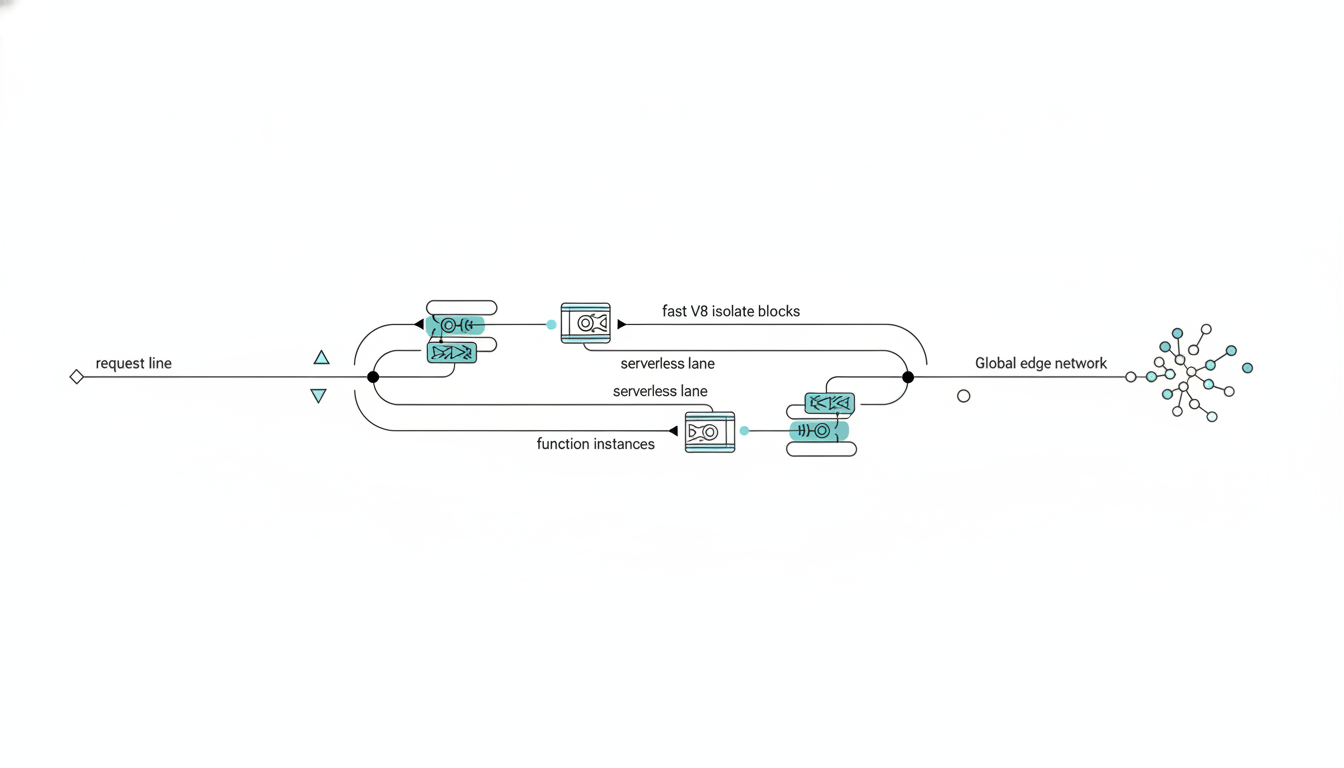
For a solo SaaS backend in 2026, I run the compute on Cloudflare Workers and reach for Vercel when the product is a Next.js app that lives and dies by its frontend DX. Workers wins on cost — a flat $5/month, zero egress fees, and CPU-only billing — while Vercel wins on framework integration and git-to-production polish. The real trap isn't picking the "wrong" platform; it's assuming Vercel's free Hobby tier can run a commercial product (it can't) or that a global edge network is free everywhere (only one of these two makes bandwidth free). I run my loops on both through 1mn, so this is the stack-specific breakdown I wish I'd had before I committed.
Here's the honest comparison, with the current numbers.
Cloudflare Workers vs Vercel: which should a solo founder pick?
Pick Cloudflare Workers when your backend is APIs, webhooks, cron jobs, and high-volume traffic; pick Vercel when your product is a Next.js frontend and you want the smoothest deploy story money can buy. That's the clean split, and almost every honest 2026 comparison lands on it.
The structural difference is how they bill. Workers charges a flat $5/month per account and meters requests and CPU-milliseconds. Vercel charges $20 per seat and, since Fluid Compute became the default, meters Active CPU, provisioned memory, and invocations separately (Vercel pricing, July 2026).
For a solo founder, that difference compounds. On Workers you pay for compute. On Vercel you also pay for a seat before you've served a single request.
What does each one cost for a real solo SaaS?
A small production SaaS runs roughly $10–25/month on Cloudflare and $30–100+/month on Vercel — a 3–5x gap that widens with traffic. That range comes from a June 2026 dev.to writeup benchmarking a SaaS at ~100k requests/day with light database use, and it matches the pattern across the other 2026 pricing analyses.
The gap has three drivers:
- The base cost. Workers Paid is $5/month flat. Vercel Pro is $20/seat/month before usage.
- Bandwidth. Cloudflare charges zero for egress on every plan. Vercel meters bandwidth beyond its included tier — and at scale that alone can be a 10x line item.
- The billing unit. Workers bills only CPU time; time spent waiting on a
fetch()or a database query is free. Vercel's Fluid Compute now does the same for Active CPU, but you still pay provisioned-memory-time for the full instance lifetime.
According to Cloudflare's Workers pricing docs (July 2026), the Paid plan's $5 includes 10 million requests and 30 million CPU-milliseconds, then $0.30 per additional million requests and $0.02 per million CPU-ms. A typical lightweight Worker uses just 1–5 CPU-ms per request, so most small apps never leave the $5 base.
The Hobby-plan trap every solo founder should know
Vercel's free Hobby plan is non-commercial only — you cannot legally run a paid SaaS on it. This is the single most expensive assumption a solo founder makes. Multiple 2026 references (including Vercel's own edge-execution docs) flag Hobby as "non-commercial use only." The moment you charge a customer, you owe Pro at $20/seat.
Cloudflare's free tier has no such restriction. 100,000 requests per day, 10ms of CPU per invocation, no credit card — and it's genuinely usable for a small commercial API or a prototype that takes real traffic (Cloudflare Workers docs, July 2026). You graduate to the $5 plan when CPU or request volume becomes real, not the day you flip on billing.
So the honest free-tier comparison isn't "both are free." It's: Cloudflare is free for small commercial workloads; Vercel is free only until you have a business.
Cold starts, CPU limits, and long-running jobs
Workers cold-start in under 5ms because they run on V8 isolates; Vercel's Node functions on Fluid Compute still pay an 800ms–2.5s cold start on a fresh instance. Vercel's own Fluid Compute changes reduce how often you hit one (they claim cold starts are avoided for 99.37% of requests on sustained production traffic), but they don't eliminate the first-invocation cost on a cold instance.
The limits that matter for backend work in 2026:
- CPU / duration. Workers Paid allows up to 5 minutes of CPU per request (30s default), and up to 15 minutes per Cron Trigger or Queue consumer — genuinely useful for background jobs. Vercel functions default to a 300-second wall-clock timeout on every plan, extendable to 800s (Pro/Enterprise), with a 1800s extended maximum.
- Wall-clock vs CPU. Vercel's timeout is wall-clock — a function waiting on a slow AI provider burns against the 300s even while the CPU sits idle. Workers' CPU limit ignores I/O wait entirely.
- The old "use Edge for speed" advice is dead. In 2026 Vercel runs middleware and route handlers on Fluid Compute with full Node.js in the same regions as Edge, so Edge Functions (with their hard, non-configurable 25-second ceiling) are no longer the default recommendation.
For a solo founder running scheduled agent jobs, the 15-minute Cron Trigger CPU budget on Workers is the quiet winner.
The data layer: where Cloudflare pulls ahead for solo builders
Cloudflare bundles a full serverless data stack — D1, R2, KV, Queues — that bills in the same $5 plan and, crucially, never charges egress. For a one-person team, having the database, object storage, and a queue on the same platform (and the same bill) removes a lot of glue.
The 2026 numbers, from Cloudflare's docs:
- D1 (SQLite at the edge): 5 GB free, then $0.75/GB-month; 25 billion rows read/month and 50 million rows written/month included on Paid.
- R2 (object storage): 10 GB-month free, $0.015/GB-month after, no egress fees — the structural win over S3-style pricing.
- Queues: as of a February 2026 change, now on the free plan too (10,000 operations/day), so background job plumbing costs nothing to start.
Vercel's equivalents (Postgres via Neon, blob storage) are perfectly good, but they're metered separately and bandwidth is not free — which is exactly where the cost gap reopens at scale.
Cloudflare Workers vs Vercel: the side-by-side
| Cloudflare Workers | Vercel (Fluid Compute) | |
|---|---|---|
| Base price | $5/mo flat (account) | $20/mo per seat |
| Free tier for a paid SaaS | Yes — 100k req/day, commercial OK | No — Hobby is non-commercial only |
| Billing unit | CPU-ms (I/O wait free) | Active CPU + provisioned memory + invocations |
| Egress / bandwidth | Free on all plans | Metered beyond included tier |
| Cold start | <5ms (V8 isolate) | ~800ms–2.5s (Node, reduced by Fluid) |
| Max job duration | 5 min CPU/request, 15 min/cron | 300s default, up to 800s (Pro) |
| Best at | APIs, webhooks, cron, high volume, edge cost | Next.js DX, git-to-prod, frontend polish |
| Data layer | D1 + R2 + KV + Queues, same bill, no egress | Postgres/Blob, metered separately |
Where 1mn fits (either platform): 1mn is not a host — it's the autonomous operations layer that runs on top of whichever you pick, with native integrations for both Cloudflare and Vercel deploys.
How I run this as a solo founder — on both
I use Cloudflare Workers for the backend and loops because the economics and the 15-minute cron budget fit background work, and I keep Vercel in the toolkit for Next.js-heavy frontends. What I don't do is babysit either one.
That's the job I handed to 1mn. It runs my solo SaaS on autonomous loops — synthetic personas dogfood the product and file bugfix PRs, the marketing loop runs content and ads routines, and support tickets get triaged — with a human gate on every irreversible action, so nothing deploys or spends without my sign-off. It integrates natively with both Cloudflare (Workers, D1, R2, Queues, Web Analytics) and Vercel (Deployments, Edge, runtime logs), so the deploy, rollback, and log-tailing plumbing is the same whichever platform a given product sits on.
The platform choice decides your bill and your cold starts. The loops decide whether a one-person team can actually keep up. If you want the reversible work automated and the expensive work gated by default, start a 14-day free trial — no per-seat pricing, cancel anytime — connect a Cloudflare or Vercel project plus GitHub, and the loops activate within the first day.
FAQ
Is Cloudflare Workers cheaper than Vercel? Yes, at nearly every scale. Workers is $5/month flat with free egress; Vercel is $20/seat plus metered bandwidth and compute. A small SaaS typically runs $10–25/month on Cloudflare versus $30–100+ on Vercel (dev.to benchmark, June 2026), and the gap widens with traffic.
Can I run a commercial SaaS on Vercel's free plan? No. Vercel's Hobby plan is non-commercial use only. The moment you charge customers you need Pro at $20/seat/month. Cloudflare's free tier has no commercial restriction.
Does Vercel still have cold starts in 2026? Yes, but fewer. Fluid Compute (now the default) reduces cold-start frequency — Vercel claims 99.37% of sustained-traffic requests avoid one — but a fresh Node instance still pays roughly 800ms–2.5s. Cloudflare Workers cold-start in under 5ms via V8 isolates.
Which is better for long-running or scheduled jobs? Cloudflare Workers, for a solo founder. It allows up to 15 minutes of CPU per Cron Trigger or Queue consumer and bills only CPU time, not I/O wait. Vercel functions cap at a 300s default wall-clock timeout (up to 800s on Pro).
Can I use both? Yes, and many solo founders do — Vercel for a Next.js frontend, Cloudflare for APIs, storage, and background jobs. Tools like 1mn integrate with both natively, so your operations loops work regardless of where each piece is deployed.
Keep reading
This post is part of the Loop Engineering: Why Agents Need Different Infrastructure guide.
1mn builds the autonomous loops that run a one-person software business — product, marketing, and support — on a schedule. We write about what we learn shipping it.